AI-assisted delivery overview
AI-assisted delivery changes how teams produce software and allocate effort. When AI generates much of the implementation, teams spend more time defining intent, validating outcomes, and governing quality. This section describes an operating model that preserves accountability and aligns with the governance lifecycle gates.
The model is principle-based and vendor-neutral. It applies across agile methods, tools, and team sizes. It describes how teams allocate effort, manage artifacts, and assign accountability when AI performs a large share of the implementation.
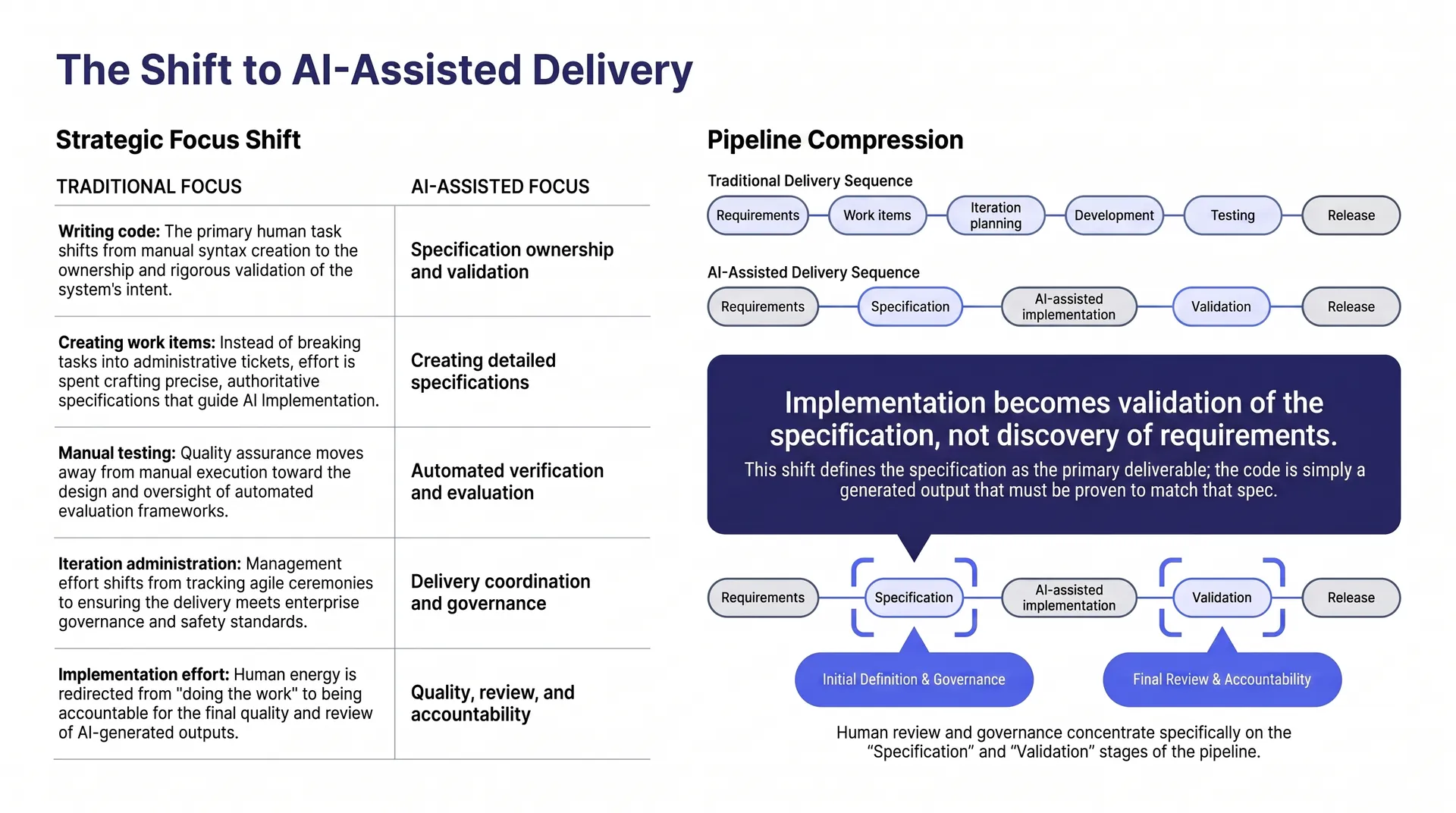
Figure: generated with NotebookLM from the framework's text · Enterprise AI Framework · CC BY 4.0
What changes
Teams organize traditional delivery around producing code and managing work items. Teams organize AI-assisted delivery around producing specifications, validating outcomes, enforcing standards, and governing delivery.
| Traditional focus | AI-assisted focus |
|---|---|
| Writing code | Specification ownership and validation |
| Creating work items | Creating detailed specifications |
| Manual testing | Automated verification and evaluation |
| Iteration administration | Delivery coordination and governance |
| Implementation effort | Quality, review, and accountability |
The specification becomes the primary deliverable. Teams complete requirements discovery before implementation and use implementation to validate the specification.
Delivery pipeline shift
The delivery sequence compresses. Specification engineering and AI-assisted implementation replace work-item decomposition and iteration planning.
flowchart TB
    subgraph T["Traditional"]
        direction LR
        T1[Requirements] --> T2[Work items] --> T3[Iteration planning] --> T4[Development] --> T5[Testing] --> T6[Release]
    end
    subgraph A["AI-assisted"]
        direction LR
        A1[Requirements] --> A2[Specification] --> A3[AI-assisted implementation] --> A4[Validation] --> A5[Release]
    end
    T ~~~ A
The removed stages represent coordination overhead. Human judgment and governance concentrate on the retained specification and validation stages.
Scope and exclusions
This section covers:
- The specification as the authoritative delivery artifact.
- How roles and accountability shift when AI generates implementation.
- How to size and structure teams, and how to decompose work.
The governance, security, and architecture sections retain authority over risk classification, authorization, threat modeling, and enterprise architecture. This section describes how delivery operates within those requirements.
Section contents
- Specification-driven delivery: the specification as the authoritative artifact, its anatomy, handoffs, and traceability.
- Roles and accountability: how roles shift and who is accountable for each outcome and gate.
- Team topologies: sizing, why more developers can slow delivery, short delivery loops, and work decomposition.
- Reference implementation: AEGIS: one open-source tool that puts this model into practice, with a mapping and its gaps.
Relationship to the rest of the framework
The delivery model applies the governance operating model at team level. Its handoffs map to the lifecycle gates, and its accountable roles map to the named accountability owners. It exercises the capability model, including AI engineering, platform and integration, and people and adoption. It also depends on well-formed context to specify systems correctly.