Roles and accountability in AI-assisted delivery
AI shifts role focus toward specifying, directing, and validating artifacts. Teams spend less time producing them. AI-assisted delivery requires collaboration, governance, accountability, and cross-functional review.
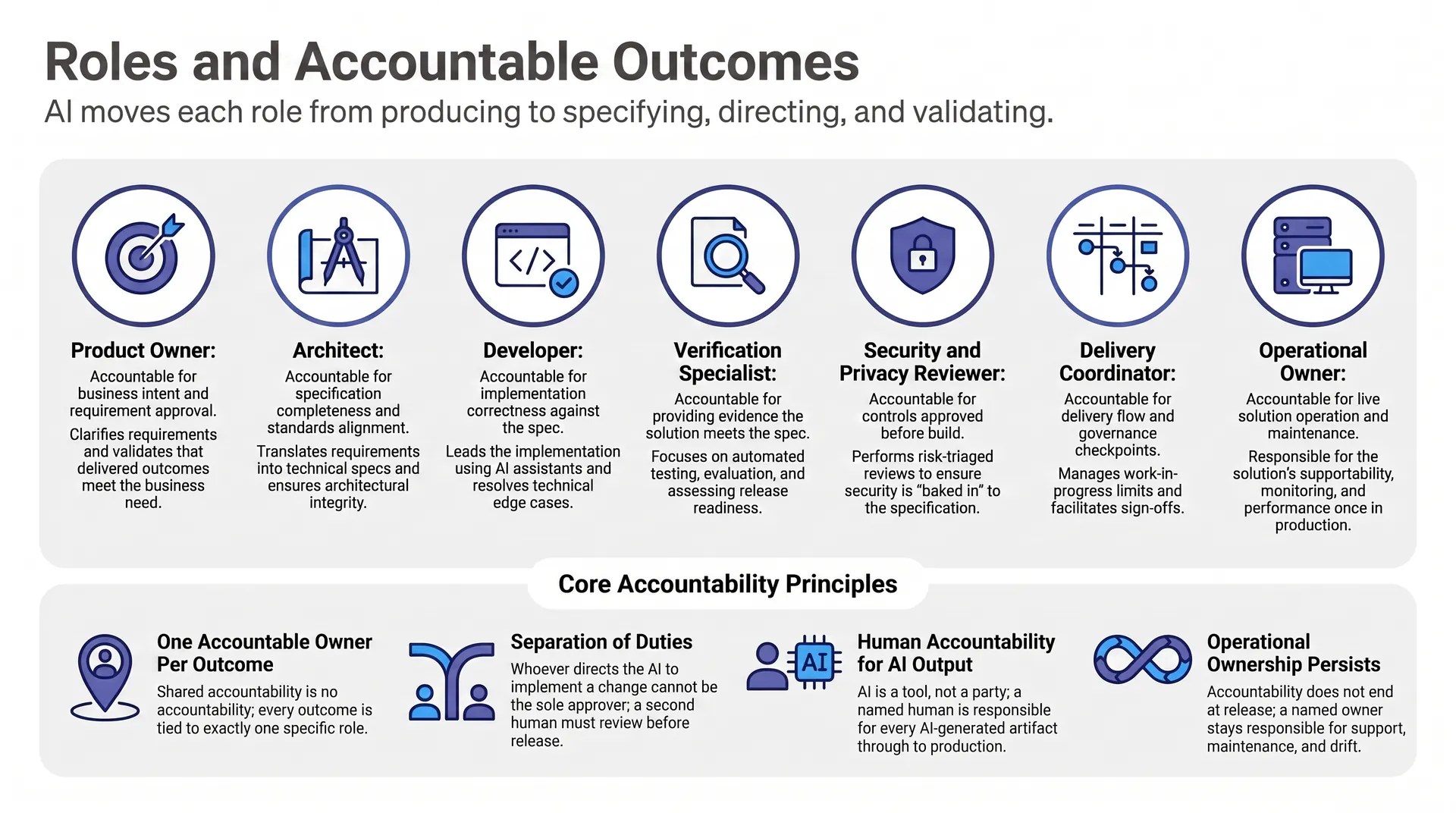
Figure: generated with NotebookLM from the framework's text · Enterprise AI Framework · CC BY 4.0
How roles shift
| Traditional focus | AI-assisted focus |
|---|---|
| Writing code | Specification ownership and validation |
| Creating work items | Creating detailed specifications |
| Manual testing | Automated verification and evaluation |
| Iteration administration | Delivery coordination and governance |
| Implementation effort | Quality, review, and accountability |
Accountability principles
These principles prevent the failure modes AI introduces: speed outrunning review, unclear ownership of generated code, and unreviewed change.
- One accountable owner per outcome. Every outcome has exactly one accountable role; others are responsible, consulted, or informed. Assigning multiple accountable roles obscures ownership.
- Separation of duties. A second human reviews changes before release, independently of the person who directed the AI implementation.
- Human accountability for AI output. A named human is accountable for every AI-generated artifact through to production.
- Operational ownership persists. A named owner remains accountable after release for the solution's supportability, maintenance, and drift.
Role definitions
Familiar role names reduce change friction. Their focus shifts as follows.
- Product owner: business intent and requirement approval. Clarifies requirements, answers open business questions, approves the requirements portion of the specification, and validates delivered outcomes. The architect and security and privacy reviewer approve their respective details.
- Architect: specification engineer. Translates requirements into detailed specifications; applies architecture, security, data, and platform constraints; defines acceptance and validation criteria; records decisions; and reviews AI-generated implementation against the specification. Teams encode standards and reusable patterns in workflow tooling. This approach applies governance consistently and reduces dependence on one person's availability.
- Developer: implementation lead. Executes implementation from approved specifications using AI coding assistants; validates generated code; performs test-driven development; resolves edge cases; and maintains the solution.
- Verification specialist: verification and evaluation. Validates implementations against the specification; executes automated testing; assesses release readiness; reviews specification testability early; and retains exploratory testing.
- Security and privacy reviewer. Performs risk-triaged review of sensitive specifications and validates security and privacy controls before implementation. A sensitivity triage step identifies specifications that require review and keeps the gate proportionate.
- Delivery coordinator. Facilitates collaboration, manages delivery flow and work-in-progress limits, coordinates dependencies, and supports governance checkpoints.
- Operational owner. Owns supportability, monitoring, incident response, and drift after release. This role gives every AI-generated production component a named owner.
Responsibility across lifecycle gates
The matrix maps delivery roles to the governance lifecycle gates. Legend: A accountable (exactly one per gate), R responsible, C consulted, I informed.
| Lifecycle gate | Product owner | Architect | Developer | Verification | Security and privacy | Delivery coordinator | Operational owner |
|---|---|---|---|---|---|---|---|
| Intake | A | C | I | I | I | R | I |
| Assessment | C | A | C | C | R | R | C |
| Design | C | A | C | C | R | I | I |
| Build and validate | I | C | A | R | C | R | I |
| Authorize and release | R | R | C | R | R | A | C |
| Operate and monitor | I | C | R | C | C | I | A |
| Change or retire | C | A | R | C | C | R | R |
Notes:
- At Authorize and release, the delivery coordinator is accountable for running the gate and confirming that required approvers submitted their sign-offs. For higher risk tiers, final authorization escalates to the designated authorization authority. Each contributor remains responsible for their own sign-off. This division preserves separation of duties.
- The architect is accountable at Assessment, Design, and Change or retire. This concentration is a bottleneck risk. Teams mitigate it by embedding governance in tooling and requiring a second approver before release.
Mapping to enterprise accountability owners
The delivery roles map to the accountability owners named in the governance operating model:
| Enterprise accountability owner | Delivery role that carries it |
|---|---|
| Service owner | Product owner |
| Risk owner | Architect (with delivery coordinator) |
| Data owner | Product owner with security and privacy reviewer |
| Model or AI engineering owner | Developer (build) with architect (design) |
| Security owner | Security and privacy reviewer |
| Privacy contact | Security and privacy reviewer |
| Operational owner | Operational owner |
| Authorization authority | Escalation point for authorize and release |
Deliverable accountability
For communication, the gate-level matrix reduces to a single accountable owner per deliverable. This is a summary view; the matrix above governs at gate level.
| Deliverable | Accountable owner |
|---|---|
| Business outcomes | Product owner |
| Specification | Architect (requirements portion: product owner) |
| Implementation quality | Developer |
| Verification and testing | Verification specialist |
| Security and privacy compliance | Security and privacy reviewer |
| Delivery coordination | Delivery coordinator |
| Live solution operation | Operational owner |